
Original Research
Risk Factors for Anastomotic Leak After Colorectal Resection: A Multivariable Analysis
Valentina Guerrero, MD*; Chen Wei, MD; Daniel Owusu, MD
Vol. 1, Issue 1 · May 26, 2026
Abstract
Background. Anastomotic leak is a serious complication after colorectal surgery. We sought independent predictors to inform risk assessment.
Methods. Retrospective cohort of 521 patients undergoing colorectal resection with primary anastomosis. Clinically significant leak was the outcome. Multivariable logistic regression was performed.
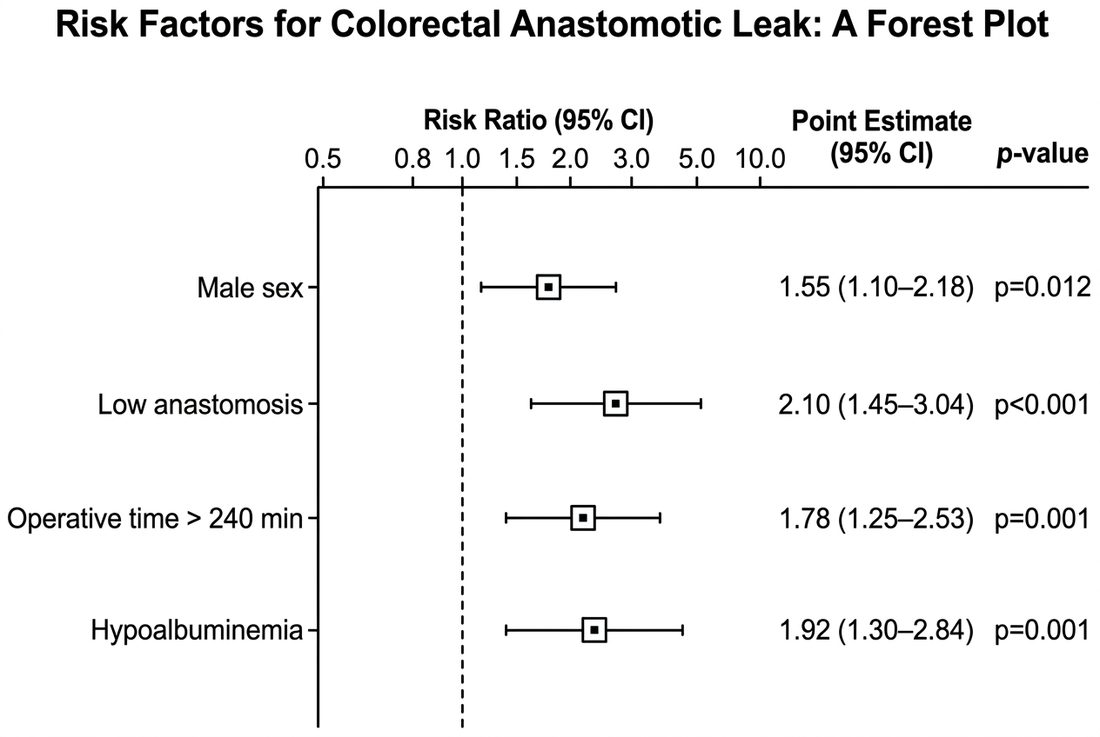
Results. Leak occurred in 42 patients (8.1%). Independent predictors were male sex (OR 1.94), low anastomosis <7 cm from the anal verge (OR 2.71), operative time >240 minutes (OR 1.86) and preoperative hypoalbuminemia (OR 2.05).
Conclusions. Anastomotic level, prolonged surgery, male sex and hypoalbuminemia independently predict leak and should guide selective diversion and optimization.
Keywords
anastomotic leakcolorectal resectionrisk factorssurgical complicationsmorbidity
INTRODUCTION
Despite advances in technique and perioperative care, anastomotic leak continues to drive morbidity, mortality and cost after colorectal resection. Recognizing modifiable and non-modifiable risk factors supports individualized decisions about fecal diversion. Anastomotic leak remains the most dreaded complication of colorectal surgery, contributing disproportionately to postoperative mortality, prolonged hospitalization and, in cancer patients, poorer oncologic outcomes. Understanding which factors are modifiable allows targeted risk reduction.
METHODS
Consecutive adults undergoing elective or urgent colorectal resection with primary anastomosis over five years were reviewed. Clinically significant leak (grade B or C) was defined per the International Study Group of Rectal Cancer. Candidate variables were entered into multivariable logistic regression.
RESULTS
Of 521 patients, 42 (8.1%) developed a leak. Leaks were associated with longer hospital stay and higher reoperation rates. In the adjusted model, male sex, low anastomosis, prolonged operative time and hypoalbuminemia were independently predictive. Leaks were associated with a higher rate of stoma creation at reoperation and a significantly longer length of stay (median 21 vs 8 days). Ninety-day mortality was higher among patients who leaked.
DISCUSSION
The identified factors align with mechanical and biological determinants of anastomotic healing. Preoperative nutritional optimization and selective diversion for low anastomoses are actionable. Single-center retrospective data limit generalizability. The identified predictors reflect both technical and host-related determinants of anastomotic healing. Strategies such as preoperative nutritional optimization, meticulous perfusion assessment and selective diversion for low anastomoses are supported by these findings. A defunctioning stoma should be considered when multiple risk factors coexist.
CONCLUSION
Simple clinical and biochemical variables predict anastomotic leak and can inform surgical strategy.
article.figures
References
- Rahbari NN, Weitz J, Hohenberger W, et al. Definition and grading of anastomotic leakage. Surgery. 2010;147(3):339-351.
- McDermott FD, Heeney A, Kelly ME, et al. Systematic review of preoperative, intraoperative and postoperative risk factors for colorectal anastomotic leaks. Br J Surg. 2015;102(5):462-479.
- Kingham TP, Pachter HL. Colonic anastomotic leak: risk factors, diagnosis, and treatment. J Am Coll Surg. 2009;208(2):269-278.
- Frasson M, Flor-Lorente B, Rodriguez JL, et al. Risk factors for anastomotic leak after colon resection. Ann Surg. 2015;262(2):321-330.