Predictive capacity of the M8 score for in-hospital mortality in adult patients: cumulative risk analysis.
Pedro Angel Rodriguez Peña, Resident*; Andrea Guadalupe Zambrano Leon, MD; Emmanuel Flores Zamudio, Resident; Dagoberto Armenta Perez, Resident; Africa Carolina Soria Olivas, Resident; Jessica Montserrat Luna Rodriguez, Resident; Brandon Javier Uriarte Zamora, MD; Edgar Saldaña Rocha, MD; Jose Alejandro Gomez, MD; Pablo Maggiani Aguilera, MD; Eduardo Lopez Diaz, Resident; Raudel Josue Santos Figueroa, MD
July 22, 2026
Abstract
Background. Accurate early prediction of in-hospital mortality is essential for optimizing clinical decision-making and resource allocation in Internal Medicine. Existing prognostic tools are often complex or designed for critically ill populations, highlighting the need for a simple and objective model based on routinely available laboratory biomarkers. This study aimed to develop and evaluate the prognostic performance of the M8 score, a cumulative laboratory-based risk model, for predicting in-hospital mortality in adult patients admitted to an Internal Medicine department.
Methods. A retrospective observational study was conducted in 1,662 adult patients hospitalized in the Internal Medicine department at Hospital General de Mazatlán between 2022 and 2025. The M8 score was developed based on eight laboratory parameters measured at admission (albumin, lactate, urea, INR, potassium, pH, sodium, and creatinine). One point was assigned for each abnormal parameter to construct a cumulative risk model for mortality prediction. The association with 7-day mortality was evaluated using Kaplan–Meier survival curves and Cox and logistic regression models.
Results. Of the 1,662 patients analyzed, 397 (23.8%) died during hospitalization. Seven-day mortality increased progressively according to M8 score categories: 12.9% in the low-risk group (0–2 points), 24.8% in the intermediate-risk group (3–5 points), and 46% in the high-risk group (≥6 points). Each additional point in the M8 score was independently associated with higher 7-day mortality (OR 1.25). The biomarkers with the strongest prognostic impact were elevated lactate, hypoalbuminemia, low pH, elevated INR, and elevated urea. Additionally, among survivors, each additional point in the score was associated with an average increase of 1.85 days in hospital length of stay.
Conclusions.
The M8 score proved to be a simple and effective prognostic tool for early risk stratification of in-hospital mortality in adult hospitalized patients. Its approach, based on routinely available laboratory biomarkers, allows early identification of high-risk patients at hospital admission and may help optimize clinical decision-making and hospital resource allocation.
In Mexico, in-hospital mortality among patients admitted to Internal Medicine departments represents a growing challenge for the healthcare system, as the population served is frequently characterized by multimorbidity, biological frailty, and overlapping acute illnesses. Has established target in-hospital mortality rates of less than 8.9% for general hospitals and up to 11% for tertiary care centers. However, many public hospitals manage patients with high clinical complexity and multiorgan dysfunction, substantially increasing the risk of in-hospital death. Mexican studies have shown that Internal Medicine departments account for a considerable proportion of hospital deaths due to the high burden of comorbidities and advanced-stage diseases among hospitalized patients. (1) In this context, the early identification of patients at increased risk of in-hospital mortality is essential to optimize clinical decision-making, improve resource allocation, and prioritize timely therapeutic interventions.
Over the past decades, several prognostic scoring systems have been developed to assess the severity of hospitalized patients. Among the most widely used are the Acute Physiology and Chronic Health Evaluation II (APACHE II) (2) and Simplified Acute Physiology Score III (SAPS III) (3) , which integrate physiological and biochemical variables to predict mortality, primarily in intensive care unit (ICU) patients. Likewise, the Sequential Organ Failure Assessment (SOFA) score (4) has demonstrated utility in assessing progressive organ dysfunction and its association with in-hospital mortality. However, the routine use of these prognostic tools in general hospital wards may be limited by their methodological complexity, the requirement for multiple clinical variables, and the time needed for score calculation.
In contrast, laboratory parameters are objective and standardized indicators of a patient's physiological status. Scientific evidence has shown that abnormalities in biomarkers such as lactate, pH, creatinine, urea, electrolytes, and albumin are independently associated with increased in-hospital mortality. Hyperlactatemia, for example, reflects tissue hypoperfusion and has been associated with increased mortality even in patients without overt hypotension. Similarly, hyponatremia, hyperkalemia, and hypoalbuminemia have been linked to a significantly higher risk of complications and death among hospitalized patients. (5-10)
In recent years, the concept of cumulative risk has gained increasing attention, proposing that clinical prognosis depends not only on a single pathophysiological abnormality but also on the simultaneous interaction of multiple organ dysfunctions. The coexistence of metabolic, renal, electrolyte, and hemostatic abnormalities may produce a synergistic effect that promotes multiorgan dysfunction and increases the risk of in-hospital mortality. From this perspective, prognostic models based on combined laboratory biomarkers have emerged as potentially valuable tools for improving clinical risk stratification. (11)
The M8 score was developed as a prognostic model based exclusively on routinely available laboratory parameters: albumin, lactate, urea, international normalized ratio (INR), potassium, pH, sodium, and creatinine. These biomarkers represent distinct pathophysiological domains, including tissue perfusion, renal function, acid–base balance, nutritional status, and electrolyte homeostasis, allowing for a comprehensive assessment of the patient's biological condition through a cumulative risk approach.
METHODS
Study Design and Population
A retrospective, observational, analytical cohort study was conducted including 1,662 adult patients with a complete laboratory profile obtained at admission to the Internal Medicine Department of Hospital General de Mazatlan between January 2022 and November 2025. Laboratory abnormality thresholds were established based on current clinical guidelines and the distribution of the study data: lactate >2.0 mmol/L, pH <7.35 (measured by arterial blood gas analysis), albumin <3.5 g/dL, international normalized ratio (INR) >1.2 (selected because it reflects early coagulation abnormalities and loss of hemostatic homeostasis, even in the absence of therapeutic anticoagulation), urea >50 mg/dL, creatinine >1.3 mg/dL, potassium >5.5 mEq/L, and sodium <135 mmol/L. The study aimed to develop a cumulative risk-based predictive model for in-hospital mortality. Specifically, the objective was to develop the M8 score and evaluate its predictive performance for in-hospital mortality among adult patients admitted to the Internal Medicine Department. Inclusion criteria comprised patients aged ≥18 years with simultaneous measurements of pH, potassium, sodium, INR, urea, creatinine, lactate, and albumin obtained at hospital admission. Exclusion criteria included patients with incomplete medical records for key study variables and those transferred to another healthcare facility.
Data Collection
Data were obtained from the institutional electronic medical records. Laboratory samples were collected at hospital admission, ensuring simultaneous measurements performed by the central laboratory under standardized quality control procedures. Written informed consent was obtained in accordance with local regulations. Patient confidentiality was protected through data anonymization using coded identifiers and restricted access to the study database. The study was approved by the Institutional Ethics Committee of Hospital General de Mazatlan “Dr. Martiniano Carvajal” (approval number CEI-2026-07) and was conducted in accordance with the principles of the Declaration of Helsinki and the Strengthening the Reporting of Observational Studies in Epidemiology (STROBE) guidelines. (12)
Statistical Analysis
A binary logistic regression model was constructed using 7-day in-hospital mortality as the dependent variable. The independent variables included in the model were albumin <3.5 g/dL, lactate >2.0 mmol/L, urea >50 mg/dL, international normalized ratio (INR) >1.2, potassium >5.5 mEq/L, pH <7.35, sodium <135 mmol/L, and creatinine >1.3 mg/dL. One point was assigned for each abnormal laboratory parameter based on its statistical significance and routine availability in clinical practice.
For the analysis of short-term mortality (7 days), survival curves were generated using the Kaplan–Meier method. Patients were stratified into three risk categories: low risk (0–2 points), intermediate risk (3–5 points), and high risk (≥6 points). Differences between survival curves were assessed using the log-rank test.
The predictive performance of the M8 score for in-hospital mortality was evaluated using logistic regression, with odds ratios (ORs) estimated for each one-point increase in the score. In addition, a multivariable component analysis was performed to determine the independent contribution of each biomarker included in the M8 score to 7-day mortality.
Among survivors, the association between the M8 score and length of hospital stay was evaluated using linear regression models, with the effect expressed as the increase in hospital stay (days) for each additional point in the score. A two-sided p value <0.05 was considered statistically significant.
Ethical Approval
The study protocol was approved by the Institutional Research Ethics Committee of the participating hospital (approval number CEI-2026-07). Data confidentiality was maintained in accordance with the Mexican General Health Law governing research involving human subjects. The study was conducted in compliance with the ethical principles of the Declaration of Helsinki.
Model Validation
Sample size adequacy was assessed using the events-per-variable (EPV) criterion, defined as the number of outcome events divided by the number of predictor variables included in the model. An EPV of ≥10 is generally considered sufficient to ensure model stability and minimize the risk of overfitting. A total of 397 patients experienced the outcome of death. Eight independent variables (pH, lactate, urea, creatinine, albumin, international normalized ratio (INR), potassium, and sodium) were included in the model, resulting in an EPV of 49.6. This value indicates that the model had adequate statistical support and can be considered stable for clinical prediction purposes. All statistical analyses were performed using R software, version 4.3.2.
RESULTS
1. Mortality
Of the 1,662 patients included in the study, 397 (23.8%) died during hospitalization and 1,265 survived. Non-survivors were older than survivors [63 years (IQR, 50–75) vs. 55 years (IQR, 43–69); p < 0.001]. (Table 1)
In-hospital mortality was more frequent among patients with a history of stroke, acute kidney injury, community-acquired pneumonia, septic shock, stroke as the primary admission diagnosis, tuberculosis, acute exacerbation of chronic obstructive pulmonary disease (COPD), other forms of shock, and unspecified malignancy. In contrast, diabetes mellitus, diabetic ketoacidosis, drug intoxication or overdose, and acute pancreatitis were less common among patients who died.
Regarding laboratory findings, non-survivors had significantly higher international normalized ratio (INR), potassium, lactate, and urea levels, as well as lower albumin and sodium concentrations compared with survivors. No significant differences were observed between groups in sex, hypertension, chronic kidney disease, heart failure, arterial pH, or creatinine levels.
Finally, the distribution of the M8 score differed significantly between survivors and non-survivors (p < 0.001), with higher scores being substantially more frequent among patients who died.
2. Seven-Day Survival Analysis
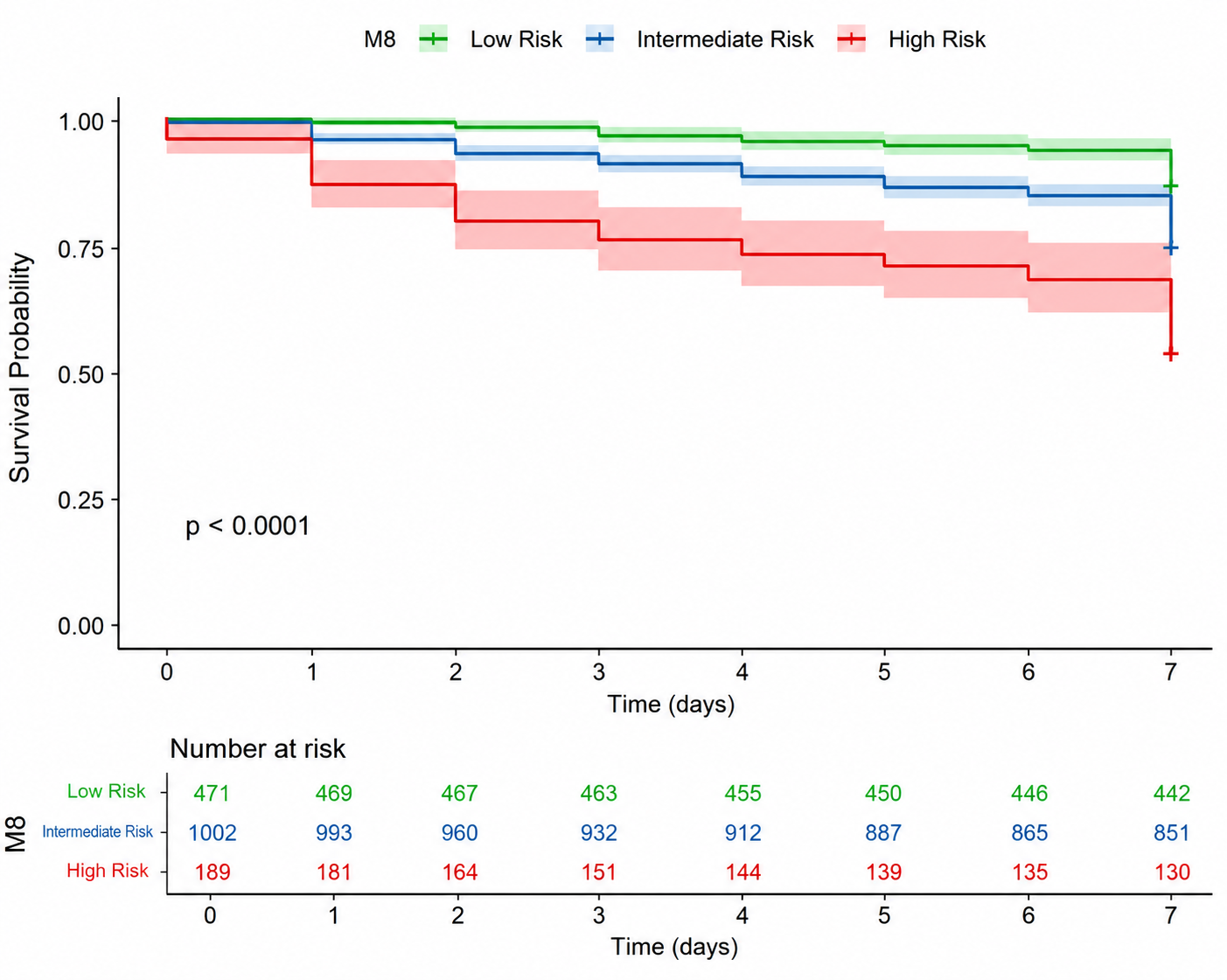
Significant differences in survival were observed among the M8 score groups (log-rank p < 0.0001). Patients with an M8 score of 0 had a 90.9% probability of survival at day 7, whereas those with an M8 score of 8 exhibited the poorest prognosis, with a 7-day survival probability of only 5.8%.
Seven-day in-hospital survival was further evaluated according to clinically defined M8 risk categories: low risk (0–2 points), intermediate risk (3–5 points), and high risk (≥6 points) (Figure 1).
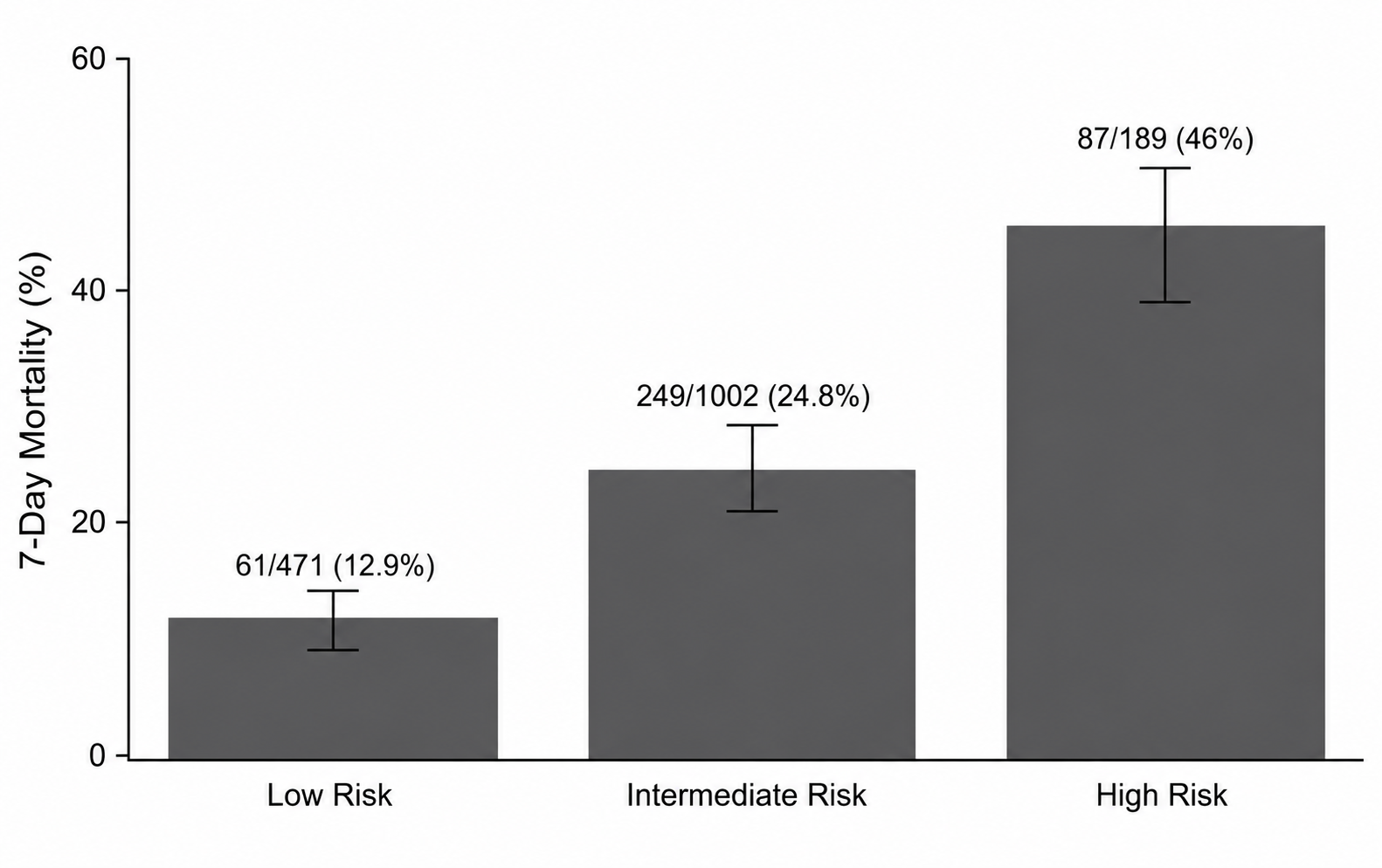
Seven-day mortality increased progressively across risk categories, reaching 12.9% (61/471) in the low-risk group, 24.8% (249/1,002) in the intermediate-risk group, and 46.0% (87/189) in the high-risk group. Compared with patients in the low-risk category (M8 score 0–2), those in the intermediate-risk category (M8 score 3–5) had a significantly higher risk of death (OR 2.06, 95% CI 1.56–2.73; p < 0.001). This association was even stronger in patients with M8 scores ≥6, who had more than a fourfold higher risk of 7-day mortality (OR 4.63, 95% CI 3.33–6.42; p < 0.001) (Figure 2).
3. Regression Models and Prognostic Factors
To evaluate the M8 score as an independent predictor of short-term mortality, Cox proportional hazards and logistic regression models were performed. After adjustment for age, sepsis, septic shock, and chronic kidney disease, the M8 score remained an independent predictor of 7-day mortality, with an odds ratio (OR) of 1.25 for each one-point increase in the score (95% CI, 1.13–1.37; p < 0.001).
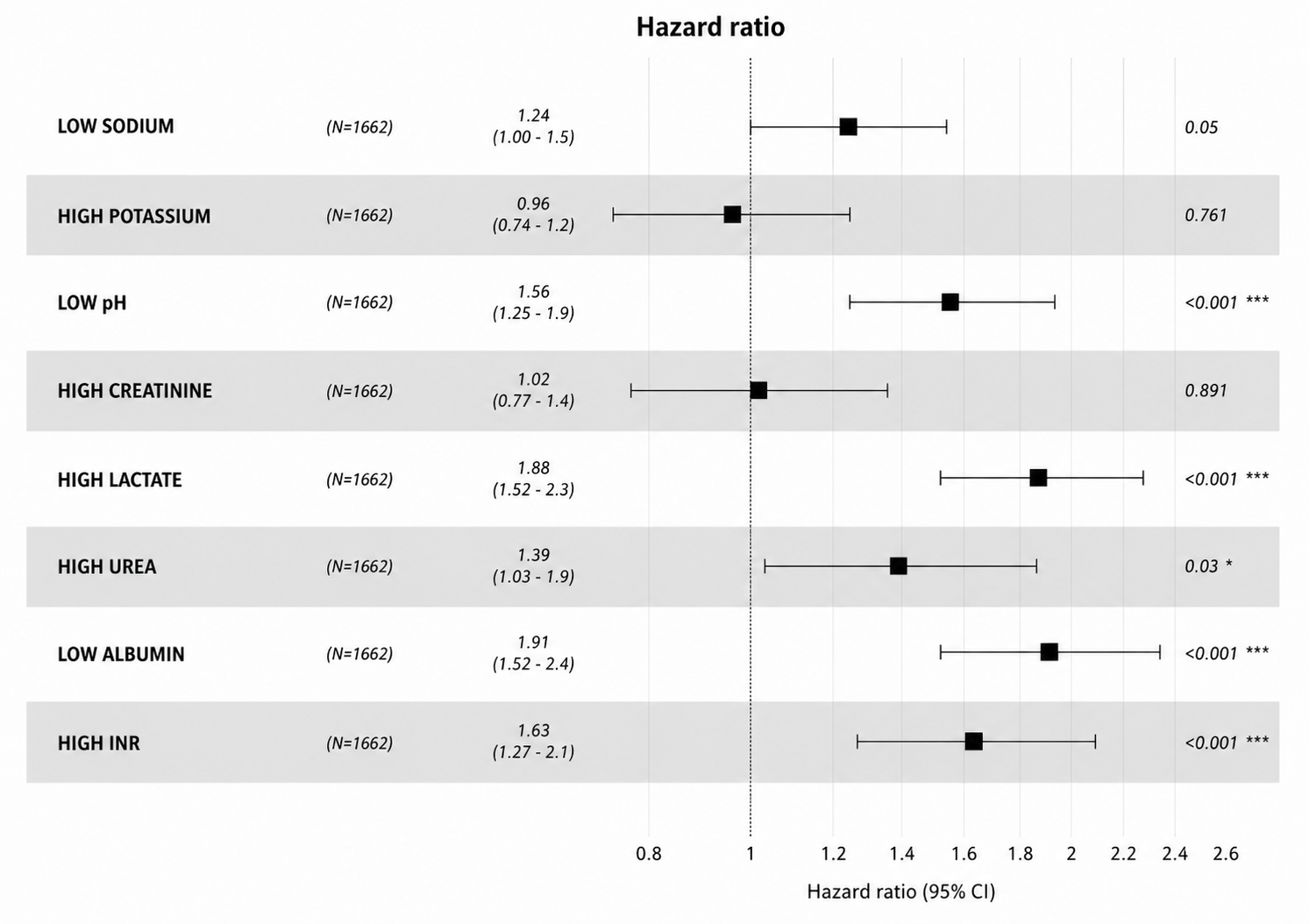
Component-level multivariable analysis demonstrated that the biomarkers with the strongest prognostic association with mortality were elevated lactate (OR 1.88, 95% CI 1.52–2.30; p < 0.001), hypoalbuminemia (OR 1.91, 95% CI 1.52–2.40; p < 0.001), low pH (OR 1.56, 95% CI 1.25–1.90; p < 0.001), elevated international normalized ratio (INR) (OR 1.63, 95% CI 1.27–2.10; p < 0.001), elevated urea (OR 1.36, 95% CI 1.03–1.90; p = 0.03), and hyponatremia (OR 1.24, 95% CI 1.00–1.50; p = 0.05). All of these variables were independently associated with an increased risk of 7-day mortality (Figure 3).
4. Length of Hospital Stay Among Survivors
Among survivors, a positive linear association was observed between the baseline M8 score and the length of hospital stay. Each one-point increase in the M8 score was associated with an average increase of 1.85 days in hospitalization. Patients with an M8 score of 0 had an estimated mean hospital stay of 2.7 days, whereas those with an M8 score of 8 had an estimated mean length of stay of 17.5 days.
DISCUSSION
The present study validated the M8 score as a simple yet robust prognostic tool for predicting in-hospital mortality in a large cohort of patients with a broad spectrum of common conditions admitted to Internal Medicine wards. Our findings demonstrate that a cumulative risk approach, based exclusively on routinely available laboratory parameters, can accurately identify patients at increased risk of fatal outcomes while also providing an estimate of the expected length of hospital stay.
Beyond its prognostic performance, the M8 score may serve as a practical tool for early clinical risk stratification, allowing healthcare providers to prioritize patients requiring closer monitoring, more intensive supportive care, and timely therapeutic interventions. In addition, the score may support decisions regarding referral to higher levels of care, particularly units capable of advanced hemodynamic and multiorgan monitoring, such as the intensive care unit (ICU).
Based on our findings, patients classified as high risk (M8 score 6–8), who exhibited substantially higher mortality rates, should be considered for early ICU evaluation as part of a comprehensive management strategy. Although admission decisions should always rely on overall clinical judgment and available resources, the M8 score may provide an objective adjunct for identifying patients who are most likely to benefit from critical care assessment.
A major strength of the M8 score lies in its ability to capture the patient's physiological burden through eight complementary biological domains. We observed that 7-day mortality increased more than threefold, rising from 12.9% in the low-risk group to 46% in the high-risk group. This marked increase supports the hypothesis that the coexistence of metabolic, electrolyte, renal, perfusion, and coagulation abnormalities produces a synergistic effect that exceeds the contribution of each individual alteration. Notably, this relationship remained evident despite the wide range of underlying diseases represented in our cohort, reinforcing the potential value of the M8 score as an objective laboratory-based tool for patient risk stratification and clinical prioritization. Among the individual components of the model, elevated lactate, metabolic acidosis reflected by a low arterial pH, hypoalbuminemia, elevated international normalized ratio (INR), and azotemia made the greatest contributions to mortality prediction. These findings are consistent with the existing literature. (5-10)
Among the individual components of the M8 score, hypoalbuminemia (OR 1.91, 95% CI 1.52–2.40; p < 0.001) and elevated lactate (OR 1.88, 95% CI 1.52–2.30; p < 0.001) exhibited the strongest prognostic associations with mortality. These findings indicate that the model captures both acute physiological derangement, reflected by tissue hypoperfusion and metabolic acidosis, and underlying biological reserve, reflected by nutritional and inflammatory status. This dual approach may explain the ability of the M8 score to accurately predict mortality in the heterogeneous population of Internal Medicine patients, regardless of age or primary diagnosis.
Unlike more complex prognostic scores such as APACHE II (2) and SAPS III (3), which require numerous physiological variables, complex clinical assessments that may depend on the examiner's expertise, and the collection of multiple clinical data points, the M8 score relies exclusively on routine laboratory parameters that are readily available in most secondary-care hospitals, typically within the first hour after hospital admission. Furthermore, whereas tools such as the SOFA score (4) primarily assess established organ dysfunction, the M8 score appears to identify early systemic vulnerability, potentially allowing earlier recognition of patients at increased risk of adverse outcomes before overt multiorgan failure develops.
A novel finding of this study is the direct association between the M8 score and length of hospital stay among survivors. Each one-point increase in the score was associated with an average prolongation of 1.85 days of hospitalization, extending the utility of the M8 score beyond mortality prediction to hospital resource management. Patients with higher scores who survive the acute phase are likely to require longer hospital stays, greater resource utilization, and closer clinical monitoring. Consequently, the M8 score may assist Internal Medicine departments in anticipating bed occupancy, optimizing resource allocation, and improving hospital capacity planning.
Notably, creatinine and potassium were not independently associated with 7-day mortality in the multivariable model. One possible explanation is the high prevalence of chronic kidney disease in our study population. In these patients, moderately elevated creatinine and potassium levels may reflect their baseline physiological status rather than an acute deterioration associated with short-term mortality. In contrast, abnormalities such as metabolic acidosis (low pH) and coagulation dysfunction (elevated INR) are more likely to represent acute systemic derangements that confer a substantially higher risk of death.
Although the inclusion of dynamic physiological variables, such as vital signs, could potentially improve the model's sensitivity for detecting impending shock, the principal strength of the M8 score lies in its reliance on objective laboratory measurements and its ability to capture the patient's underlying biological reserve. By avoiding the variability and potential recording bias associated with manually documented vital signs, the M8 score preserves its simplicity, reproducibility, and ease of implementation in routine clinical practice. These characteristics constitute a fundamental feature of the model and enhance its practical value as a bedside risk stratification tool, providing rapid prognostic information that can support timely clinical decision-making.
Despite the large sample size, this study was conducted at a single secondary-care hospital in Mazatlan, Mexico, which may limit the generalizability of the proposed cutoff values to populations with different epidemiological and clinical characteristics. In addition, the retrospective study design carries an inherent risk of information bias; however, this limitation was mitigated by the use of electronic medical records and objective laboratory measurements.
Another limitation is that the analysis was based exclusively on laboratory values obtained at the time of hospital admission. Consequently, it was not possible to evaluate the temporal evolution of the biomarkers included in the M8 score. In particular, systematic follow-up measurements were not available, preventing assessment of whether the resolution or persistence of metabolic abnormalities was associated with changes in survival probability. Serial evaluation of these biomarkers may provide additional insight into the utility of the M8 score not only as an initial prognostic tool but also as a potential indicator of treatment response and disease progression.
CONCLUSION
In conclusion, the present study validates the M8 score as a practical, accurate, and clinically relevant prognostic tool for adult patients admitted to Internal Medicine. The score demonstrated strong predictive performance for early in-hospital mortality, supporting its use as an objective screening tool for early risk stratification. In addition, its direct association with length of hospital stay suggests potential value for hospital resource management, including patient prioritization, bed utilization, and clinical workflow planning. Because it is based exclusively on routinely available laboratory parameters, the M8 score is readily applicable in both secondary- and tertiary-care hospitals.
Our findings further support the concept that patient prognosis is determined not by isolated biomarkers but by the synergistic interaction of multiple physiological disturbances. By integrating pH, lactate, albumin, international normalized ratio (INR), urea, sodium, potassium, and creatinine into a cumulative risk model, the M8 score captures the patient's overall biological vulnerability more comprehensively than single-parameter approaches, providing a simple and objective framework for early clinical risk assessment.
article.figures
Figure 1. Kaplan–Meier Survival Curves Stratified by M8 Risk Categories (Low Risk: 0–2, Intermediate Risk: 3–5, High Risk: 6–8) Figure 2. Seven-Day Mortality Rates According to M8 Score Risk Categories Figure 3. Forest plot of the independent associations between individual M8 score components and 7-day mortality.
References
Ojeda E, Duarte J, Morbimortalidad en el servicio de Medicina Interna del Hospital General Toluca del PRI Dr. Nicolás San Juan, en el periodo comprendido del 2009 al 2011, 2013, URI:http://ri.uaemex.mx/handle/20.500.11799/13777
Knaus WA, Draper EA, Wagner DP, Zimmerman JE. APACHE II: a severity of disease classification system. Crit Care Med. 1985 Oct;13(10):818-29. PMID: 3928249.
Metnitz PG, Moreno RP, Almeida E, Jordan B, Bauer P, Campos RA, Iapichino G, Edbrooke D, Capuzzo M, Le Gall JR; SAPS 3 Investigators. SAPS 3--From evaluation of the patient to evaluation of the intensive care unit. Part 1: Objectives, methods and cohort description. Intensive Care Med. 2005 Oct;31(10):1336-44. doi: 10.1007/s00134-005-2762-6. Epub 2005 Aug 17. PMID: 16132893; PMCID: PMC1315314.
Vincent JL, Moreno R, Takala J, Willatts S, De Mendonça A, Bruining H, Reinhart CK, Suter PM, Thijs LG. The SOFA (Sepsis-related Organ Failure Assessment) score to describe organ dysfunction/failure. On behalf of the Working Group on Sepsis-Related Problems of the European Society of Intensive Care Medicine. Intensive Care Med. 1996 Jul;22(7):707-10. doi: 10.1007/BF01709751. PMID: 8844239.
Kidney Disease: Improving Global Outcomes (KDIGO) Acute Kidney Injury Work Group. (2012). KDIGO Clinical Practice Guideline for Acute Kidney Injury. Kidney International Supplements, 2(1), 1–138.
Waikar SS, Mount DB, Curhan GC. Mortality after hospitalization with mild, moderate, and severe hyponatremia. Am J Med. 2009 Sep;122(9):857-65. doi: 10.1016/j.amjmed.2009.01.027. PMID: 19699382; PMCID: PMC3033702.
Einhorn LM, Zhan M, Hsu VD, Walker LD, Moen MF, Seliger SL, Weir MR, Fink JC. The frequency of hyperkalemia and its significance in chronic kidney disease. Arch Intern Med. 2009 Jun 22;169(12):1156-62. doi: 10.1001/archinternmed.2009.132. PMID: 19546417; PMCID: PMC3544306.
Goldwasser P, Feldman J. Association of serum albumin and mortality risk. J Clin Epidemiol. 1997 Jun;50(6):693-703. doi: 10.1016/s0895-4356(97)00015-2. PMID: 9250267.
Jeffrey A. Kraut, Ira Kurtz, Use of base in the treatment of severe acidemic states, American Journal of Kidney Diseases, Volume 38, Issue 4, 2001, Pages 703-727, ISSN 0272-6386, https://doi.org/10.1053/ajkd.2001.27688.
Wang S, Ding S, Luo H, Chai X. International Normalized Ratio to Albumin Ratio (PTAR): An Objective Risk Stratification Tool in Patients with Sepsis. Int J Gen Med. 2021 May 12;14:1829-1841. doi: 10.2147/IJGM.S305085. PMID: 34012289; PMCID: PMC8126875.
Jarvis S, Kovacs C, Briggs J, Meredith P, Schmidt PE, Featherstone PI, Prytherch DR, Smith GB. Aggregate National Early Warning Score (NEWS) values are more important than high scores for a single vital signs parameter for discriminating the risk of adverse outcomes. Resuscitation. 2015 Feb;87:75-80. doi: 10.1016/j.resuscitation.2014.11.014. Epub 2014 Nov 26. PMID: 25433295.
Von Elm E, Altman DG, Egger M, Pocock SJ, Gøtzsche PC, Vandenbroucke JP; STROBE Initiative. The Strengthening the Reporting of Observational Studies in Epidemiology (STROBE) statement: guidelines for reporting observational studies. J Clin Epidemiol. 2008 Apr;61(4):344-9. doi: 10.1016/j.jclinepi.2007.11.008.
How to cite this article
Pedro Rodriguez P., Andrea Zambrano L., Emmanuel Flores Z., et al. Predictive capacity of the M8 score for in-hospital mortality in adult patients: cumulative risk analysis. Clin Surg Rev. 2026.