Rankin-based scale at admission as a predictor of lower respiratory tract infection in patients hospitalized for stroke
Emmanuel Flores Zamudio, Resident*; Pedro Angel Rodriguez Peña, Resident; Eduardo López Díaz, Resident; África Carolina Soria Olivas, Resident; Jose Ramon Gamez Diaz, Resident; Alexis Lizarraga Alvarez, Undergraduate Medical Student; Kevin Alonso Smith Zamora, Undergraduate Medical Student; Maribel López Hernández, Undergraduate Medical Student; Joel David Gaxiola Lazaga, MD; Pablo Maggiani Aguilera, MD
October 25, 2026
Abstract
Background. Lower respiratory tract infection (LRTI) is a frequent and severe complication in stroke, associated with increased morbidity, mortality, and hospital stay. Early risk identification allows for timely preventive interventions.
Methods. A retrospective observational study was conducted in 58 consecutive stroke patients. Clinical variables, modified Rankin Scale (mRS) score at admission, comorbidities, and mortality were analyzed. The primary outcome was the development of LRTI. Firth's penalized logistic regression and discriminative evaluation using ROC curves were utilized. The objective of this article is to evaluate the discriminative performance of the modified Rankin Scale (mRS) score at hospital admission as a practical predictor for the risk of lower respiratory tract infection (LRTI) in patients hospitalized for acute stroke.
Results. Out of 262 patients evaluated, 58 were included. The incidence of LRTI was 17.2% (n = 10). An mRS score of 5 at admission was significantly associated with LRTI (42.8%, n = 9/21 vs. 2.7%, n = 1/37 in mRS < 5; p = 0.008), constituting an independent predictor (OR = 25.3, 95% CI: 3.0 - 1206; p = 0.0002). The model showed an area under the curve (AUC) of 0.825, a sensitivity of 90%, and a specificity of 75%. Overall mortality was 22.4% (n = 13), with 3 (30%) deaths in the LRTI group and 10 (20.8%) in the non-LRTI group.
Conclusions. The degree of neurological disability at admission, as assessed by the mRS score, exhibits a favorable exploratory value for predicting LRTI in patients with acute stroke. Given the limited sample size and wide confidence intervals, these findings warrant further validation in prospective and multicenter cohorts prior to recommending their systematic clinical implementation.
Stroke is positioned as one of the leading causes of mortality and acquired disability in adults worldwide. Beyond the primary neurological damage, the prognosis of these patients is drastically conditioned by in-hospital medical complications. (1) Among these, lower respiratory tract infections, and particularly stroke-associated pneumonia or aspiration pneumonia, represent the most frequent and devastating complication. Current evidence indicates that the development of post-stroke pneumonia not only significantly prolongs hospital stays and increases care costs, but also multiplies the risk of short- and long-term mortality, substantially limiting the patient's chances of functional recovery. (2)
The pathophysiology underlying post-stroke lower respiratory infection is complex and multifactorial. It primarily stems from the disruption of the airway's protective mechanisms due to an altered state of alertness, the presence of dysphagia, severe neurological impairment, and prolonged immobility. In addition to bulbar dysfunction, the phenomenon of stroke-induced immunodepression has been described, which increases the patient's susceptibility to early bacterial infections. Given this vulnerability, early risk stratification and detection of high-risk patients is a fundamental pillar for the timely implementation of preventive measures. (3,4)
In current clinical practice, there are various tools designed to assess aspiration risk, such as the Gugging Swallowing Screen (GUSS). Although these assessments are highly sensitive and useful, their systematic application often requires trained personnel, increased assessment time, and a level of patient cooperation that is frequently unfeasible in settings of acute and severe neurological deterioration. Therefore, there remains a pressing need for simple, universal clinical markers that are immediately available upon hospital admission to objectively anticipate this risk without delaying the initial approach. (4,5)
In this context, the modified Rankin Scale (mRS) stands out as one of the most standardized tools for assessing the degree of overall neurological disability and dependence. Although its routine use is well established for measuring long-term functional outcomes, its utility as an acute and independent predictor for the development of in-hospital lower respiratory infectious complications has not been fully established. We hypothesize that a severe degree of initial disability, quickly quantified by this scale, encapsulates the sum of anatomical and functional risk factors predisposing to pneumonia.
Consequently, the primary objective of this study was to evaluate the clinical utility and discriminative performance of the modified Rankin Scale score at hospital admission as an immediate clinical predictor for the development of lower respiratory tract infection in patients with acute stroke.
METHODS
An observational, retrospective, analytical study was conducted among adult patients hospitalized for stroke in the Internal Medicine Department of a secondary-care hospital in Sinaloa, Mexico. A total of 262 medical records corresponding to the period from January 2023 through January 2026 were consecutively reviewed. The study sample was selected according to the following eligibility criteria:
Inclusion criteria: Patients aged 18 years or older, hospitalization in the Internal Medicine department, confirmed diagnosis of stroke (ischemic or hemorrhagic) through clinical assessment and cranial computed tomography at admission, complete record of the modified Rankin Scale (mRS) score at hospital admission.
Exclusion criteria: Incomplete clinical records regarding key variables for the primary analysis (lack of mRS record at admission, absence of neuroimaging reports, or no data on in-hospital pulmonary follow-up), patients under 18 years of age, unconfirmed stroke diagnosis or presence of stroke mimics, such as isolated seizures, metabolic encephalopathy, or brain tumors, premature transfer to another institution or loss of in-hospital follow-up prior to the resolution of the acute episode, incomplete key laboratory or imaging studies at admission.
Elimination criteria: Duplicate records in the institutional database, records with uncorrectable data entry errors or logical inconsistencies, study Variables Clinical characteristics at admission were recorded, including the modified Rankin Scale (mRS) score, the presence of chronic obstructive pulmonary disease, type 2 diabetes mellitus, heart failure, chronic kidney disease, and a history of seizures. Likewise, the compromised vascular territory was documented according to clinical and neuroimaging findings.
The primary outcome was the development of a lower respiratory tract infection, specifically operationalized as Stroke-Associated Pneumonia (SAP). This was defined as an infectious process of the pulmonary parenchyma triggered during the first 7 days following the onset of the stroke in a patient without evidence of a previous respiratory infection or one in the incubation period at the time of admission. According to the consensus criteria of the Pneumonia in Stroke Consensus Group (PISCES), the recommendations of the European Stroke Organisation (ESO), and updated clinical guidelines, (3, 6, 7) diagnostic confirmation required the mandatory presence of a newly appearing radiological criterion (bronchoalveolar infiltrate, parenchymal consolidation, or cavitation on chest X-ray or computed tomography manifested after 24 hours of admission), accompanied by at least two of the following clinical or laboratory findings: a) fever greater than or equal to 38.0 °C; b) newly appearing purulent tracheobronchial secretions or a change in their characteristics; c) pathological pulmonary auscultation (crackles or rhonchi); d) deterioration of gas exchange (tachypnea greater than 20 bpm or peripheral oxygen saturation SpO2 less than 90% on room air); e) altered leukocyte response (leukocytes greater than 12,000/µL or less than 4,000/µL); or f) elevation of acute phase reactants (C-reactive protein greater than 10 mg/L).
Statistical Analysis Categorical variables were reported as absolute frequencies and proportions, while continuous variables were described with means and standard deviations, or medians and interquartile ranges, depending on their distribution. To evaluate bivariate associations between clinical variables and the development of lower respiratory infection, Fisher's exact test was used for categorical variables, and Welch's t-test or the Mann-Whitney U test for continuous variables, as appropriate. Given the low number of primary outcome events (n=10), and with the aim of controlling for data separation bias and obtaining precise estimates, a Firth's penalized logistic regression model was constructed to identify independent predictors of lower respiratory infection. The model's discrimination capacity was evaluated by constructing receiver operating characteristic (ROC) curves and calculating the area under the curve (AUC), determining the corresponding sensitivity and specificity. A two-tailed p-value < 0.05 was considered statistically significant. All statistical analyses were performed using rStudio software.
RESULTS
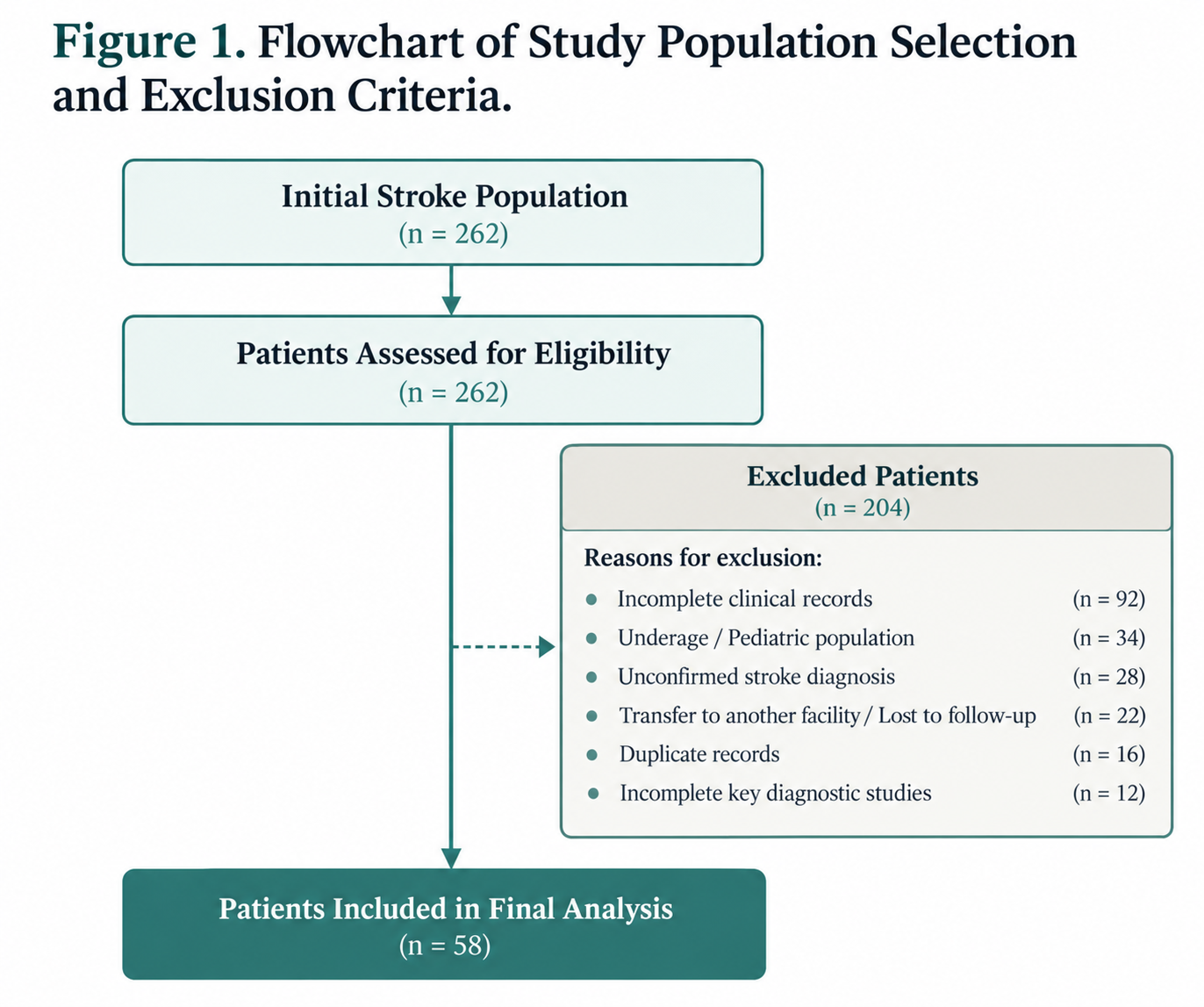
From the evaluated cohort, 58 patients from 01/01/2023 to 01/31/2026 were included in the final analysis (Figure 1). During the in-hospital evolution, 10 of these patients (17.2%) developed a lower respiratory tract infection.
In the final analysis, 58 patients with a mean age of 71.7 ± 12.7 years were included. The male sex predominated (33 patients, 56.9%), with a male:female ratio of 1.32:1. Arterial hypertension was the most frequent comorbidity (48 patients, 82.8%), followed by type 2 diabetes mellitus (21, 36.2%), history of stroke (13, 22.4%), and chronic kidney disease (6, 10.3%). The most frequently affected vascular territory was the middle cerebral artery, with 43 cases (74.1%), followed by the posterior circulation, with 9 cases (15.5%). Thrombolysis as a reperfusion strategy was performed in 7 patients (12.1%). At admission, 37 patients (63.8%) presented severe neurological disability, defined by a score of 4 or 5 on the modified Rankin Scale (mRS); specifically, 21 patients (36.2%) presented an mRS of 5. Overall in-hospital mortality was 22.4% (13/58). In the group that developed a respiratory infection, 3 out of 10 patients (30.0%) died, while in the group without respiratory infection, 10 deaths were recorded among 48 patients (20.8%) (Table 1).
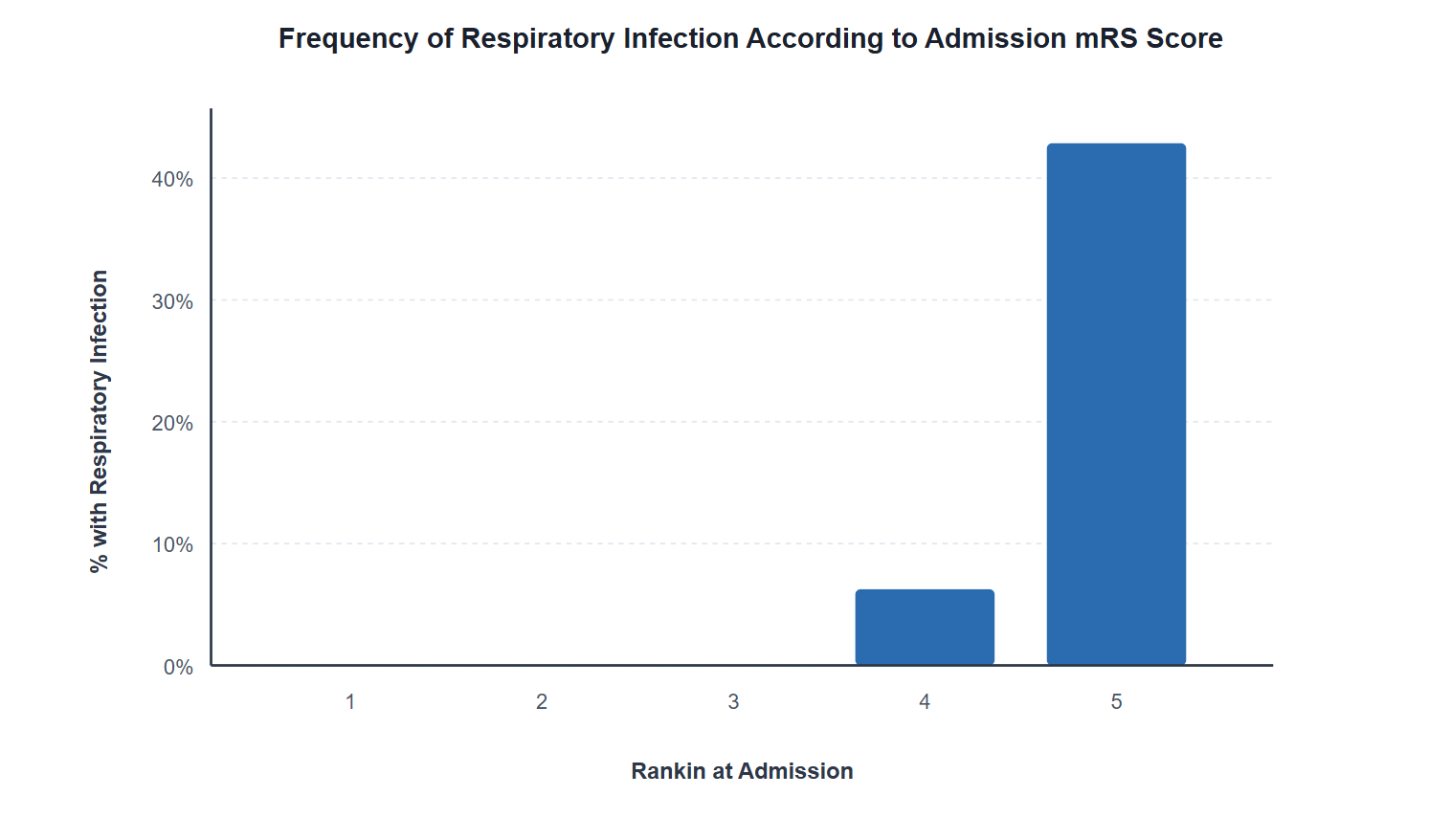
When analyzing the association between the degree of neurological disability at admission and the development of lower respiratory tract infections, a higher frequency of this complication was observed as the modified Rankin Scale (mRS) score increased, with a statistically significant association (p = 0.008). Among patients with mild to moderate disability (mRS 1–3), no cases of infection were recorded (0/21; 0.0%). In those with severe disability (mRS 4), infection was identified in 1 out of 16 patients (6.25%). The highest frequency was observed in patients with an mRS of 5, with 9 out of 21 cases (42.9%). By dichotomizing the population according to the severity of the disability, patients with an mRS of 5 presented a higher frequency of lower respiratory tract infections compared to those with an mRS <5 (42.9% vs. 2.7%), a difference that was statistically significant (Figure 2).
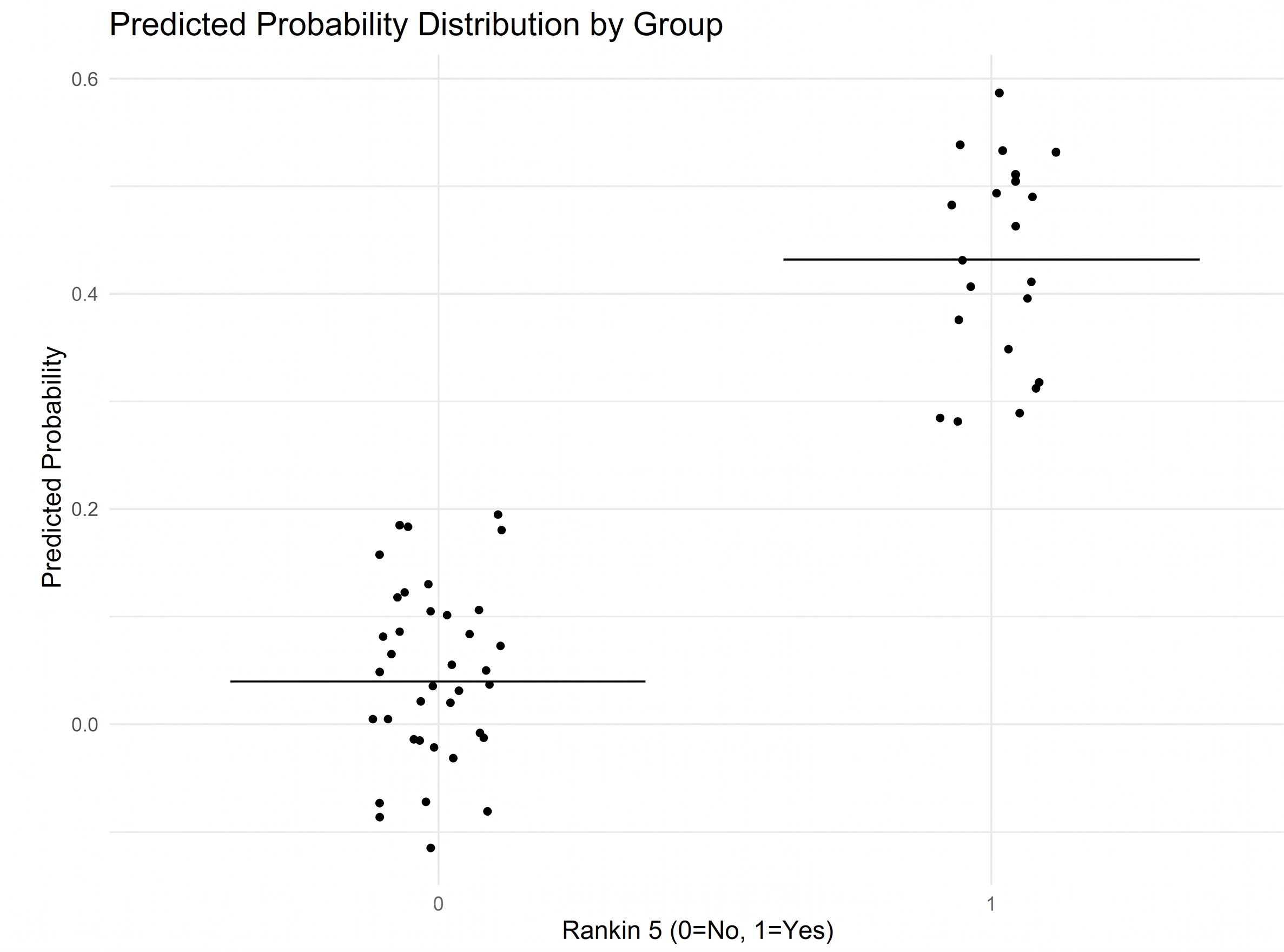
To confirm the magnitude of this effect and control for possible confounding variables, a Firth's penalized logistic regression model was performed. This analysis demonstrated that a Rankin score of 5 at admission stands as a strong clinical predictor, independently increasing the risk of lower respiratory infection by more than 25 times (OR 25.3; 95% CI 3.0–1206; p=0.0002) (Figure 3).
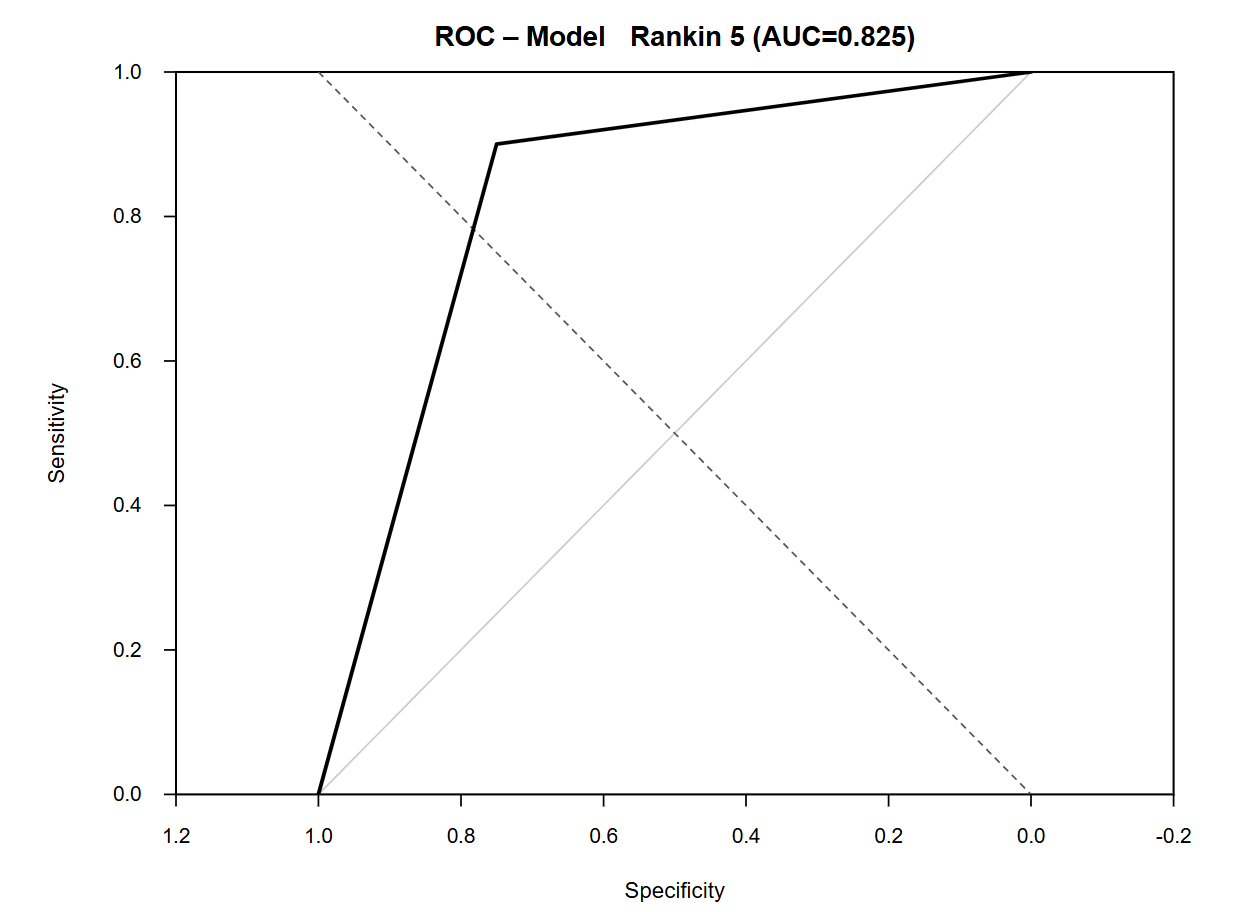
Finally, when evaluating the validity and diagnostic performance of this parameter, the predictive model based on the presence of a Rankin score of 5 demonstrated adequate discriminative capacity, evidenced by an area under the curve (AUC) of 0.825 (Figure 4). From the standpoint of its applicability, this clinical categorization achieved a sensitivity of 90% and a specificity of 75% for the early identification of patients at risk.
DISCUSSION
The main finding of the present study demonstrates that the degree of neurological disability at admission, standardized by the modified Rankin Scale, constitutes a strong and independent early clinical predictor for the development of lower respiratory tract infections in patients hospitalized for stroke.
Notably, the results reveal that patients admitted with a Rankin score of 5 have a greater than 25-fold increased risk of developing this in-hospital complication. This remarkable magnitude of association reflects the profound impact that severe neurological deterioration exerts on the integrity of the airway's protective physiological mechanisms. These findings are fully consistent with the documented pathophysiology of post-stroke pneumonia, where the loss of functional autonomy and extensive neurological damage invariably converge in the appearance of dysphagia, abolition or reduction of the cough reflex, and prolonged immobility syndromes. (3, 8, 9)
Unlike other clinical assessment tools that may be exhaustive or require specialized training, the use of the modified Rankin Scale for predictive purposes offers substantial operational advantages. Its inherent simplicity and almost universal application in neurology guarantee immediate availability from the moment of hospital admission, allowing for direct clinical applicability in emergency settings. In addition to its high overall discriminative capacity, the high negative predictive value observed suggests that this approach is particularly valuable and safe for early discernment of low-risk patients.
From a translational approach, early risk stratification using this scale has direct implications for in-hospital management. The rapid identification of patients categorized as high-risk (Rankin 5) justifies the mobilization of resources and the proactive implementation of early preventive interventions. This facilitates the rigorous establishment of airway protection measures, the priority indication for formal swallowing assessments prior to initiating oral intake, and the establishment of much closer clinical and respiratory monitoring throughout their hospital stay.
Regarding the therapeutic approach, the identification of high-risk patients using an mRS score of 5 should not be interpreted as an indication for the systematic or prophylactic use of antimicrobials. Preventive antibiotic therapy is not routinely recommended in patients with acute stroke, according to the recommendations of the American Heart Association/American Stroke Association (AHA/ASA) and the European Stroke Organisation (ESO), supported by recent meta-analyses of randomized clinical trials that have not demonstrated a significant reduction in the incidence of pneumonia or in three-month mortality, in addition to considering the risk of selection and development of antimicrobial resistance. (1, 6, 10, 11)
In this context, the clinical utility of identifying patients with an mRS of 5 lies mainly in recognizing a more vulnerable group that could benefit from closer clinical monitoring and the early implementation of non-pharmacological preventive measures. These include evaluation and protection of the airway, withholding oral intake until the swallowing assessment is completed, proper patient positioning, and oral hygiene and secretion management measures, in accordance with clinical conditions and institutional protocols. (3, 4) Therefore, stratification using the mRS could help guide targeted prevention and surveillance strategies, without inherently implying the initiation of prophylactic antimicrobial treatment.
The present study has relevant clinical strengths. Notably, the use of a universal, immediate, and zero-cost tool, capable of being applied from the initial assessment in the emergency department. With a 90% sensitivity for an mRS of 5 to predict lower respiratory tract infection, it constitutes a rapid and highly replicable filter, especially valuable in secondary care hospitals that lack specialized personnel available 24 hours a day to perform complex functional assessments.
However, methodological limitations must be acknowledged. The retrospective and single-center nature of the study, coupled with the loss of cases due to incomplete records that reduced the analyzed cohort to 58 patients (out of 262 evaluated), may restrict statistical power and introduce selection biases. Furthermore, a direct comparison against specific bedside swallowing screening tools, such as the GUSS (Gugging Swallowing Screen) scale, was not performed.5 Prospective and multicenter studies are required to externally validate this predictive model.
CONCLUSION
In conclusion, severe neurological disability at hospital admission, quantified by an mRS score of 5, is significantly associated with a higher risk of lower respiratory tract infection in stroke patients. While these results suggest that the mRS may serve as an accessible parameter for early risk stratification, the findings must be interpreted as exploratory due to the small sample size and wide confidence intervals. Further prospective studies and validation in larger independent, multicenter cohorts are required to confirm its predictive utility before recommending its systematic integration into routine clinical practice.
article.figures
Figure 1. Flowchart of Study Population Selection and Exclusion Criteria.Figure 2. Frequency of Respiratory Infection According to Admission mRS Score Categories (Scores 1–5).Figure 3. Predicted Probability Distributions Stratified by Presence (1=Yes) or Absence (0=No) of Admission Rankin 5 Score.Figure 4. ROC Curve of Admission Rankin 5 Model with Area Under the Curve (AUC = 0.825).
References
Powers WJ, Rabinstein AA, Ackerson T, Adeoye OM, Bambakidis NC, Becker K, et al. 2019 update to the 2018 guidelines for the early management of acute ischemic stroke: A guideline for healthcare professionals from the American Heart Association/American Stroke Association. Stroke. 2019;50(12):e344-e418. doi: 10.1161/STR.0000000000000211
Fonseca AC, Merwick Á, Dennis M, Ferrari J, Ferro JM, Kelly P, et al. European Stroke Organisation (ESO) guidelines on management of transient ischaemic attack. Eur Stroke J. 2021;6(2):CLXIII-CLXXXVI. doi: 10.1177/2396987321992905
Smith CJ, Kishore AK, Vail A, Chamorro A, Garau J, Hopkins SJ, et al. Diagnosis of stroke-associated pneumonia: Recommendations from the Pneumonia in Stroke Consensus Group. Stroke. 2015;46(8):2335-2340. doi: 10.1161/STROKEAHA.115.009617
Eltringham SA, Kilner K, Gee M, Sage K, Bray BD, Pownall S, et al. Impact of dysphagia assessment and management on risk of stroke-associated pneumonia: A systematic review. Cerebrovasc Dis. 2018;46(3-4):99-107. doi: 10.1159/000492730
Trapl M, Enderle P, Nowotny M, Teuschl Y, Matz K, Dachenhausen A, et al. Dysphagia bedside screening for acute-stroke patients: the Gugging Swallowing Screen. Stroke. 2007;38(11):2948-2952. doi: 10.1161/STROKEAHA.107.483933
Meisel A, et al. European Stroke Organisation (ESO) guideline on stroke-associated pneumonia. Eur Stroke J. 2026. doi: 10.1093/esj/aakag044
Kuroda S, et al. Cerebral microbleeds is a predictor of recurrent small vessel cerebrovascular disease. J Stroke Cerebrovasc Dis. 2024. doi: 10.1016/j.jstrokecerebrovasdis.2024.107812
Hoffmann S, Harms H, Ulm L, Nabavi DG, Mackert BM, Schmehl I, et al. Stroke-induced immunodepression and dysphagia independently predict stroke-associated pneumonia - The PREDICT study. J Cereb Blood Flow Metab. 2017;37(12):3671-3682. doi: 10.1177/0271678X16671964
Chamorro Á, Meisel A, Planas AM, Urra X, van de Beek D, Veltkamp R. The immunology of acute stroke. Nat Rev Neurol. 2012;8(7):401-410. doi: 10.1038/nrneurol.2012.98
Westendorp WF, Vermeij JD, Smith CJ, et al. Preventive antibiotic therapy in acute stroke patients: A systematic review and meta-analysis of individual patient data of randomized controlled trials. Eur Stroke J. 2021;6(4):385-394. doi: 10.1177/23969873211056445
Wang Q, et al. The efficacy and safety of prophylactic antibiotics for post-acute stroke infection: a systematic review and meta-analysis. Br J Clin Pharmacol. 2023. doi: 10.1111/bcp.15646
How to cite this article
Emmanuel Flores Z., Pedro Rodriguez P., Eduardo López D., et al. Rankin-based scale at admission as a predictor of lower respiratory tract infection in patients hospitalized for stroke. Clin Surg Rev. 2026.