Original Research

Predictors of Post-Induction Hypotension in Elective Non-Cardiac Surgery: A Prospective Cohort Study

Mariana Salazar, MD*; Diego Fuentes, MD; Layla Haddad, MD, PhD
Vol. 1, Issue 1 · February 25, 2026

Abstract

Background. Post-induction hypotension (PIH) is common after anesthetic induction and has been linked to postoperative organ injury. We aimed to identify independent predictors of PIH in elective non-cardiac surgery.

Methods. We prospectively enrolled 412 adults undergoing elective non-cardiac surgery under general anesthesia. PIH was defined as a mean arterial pressure <65 mmHg within 10 minutes of induction. Multivariable logistic regression identified independent predictors.

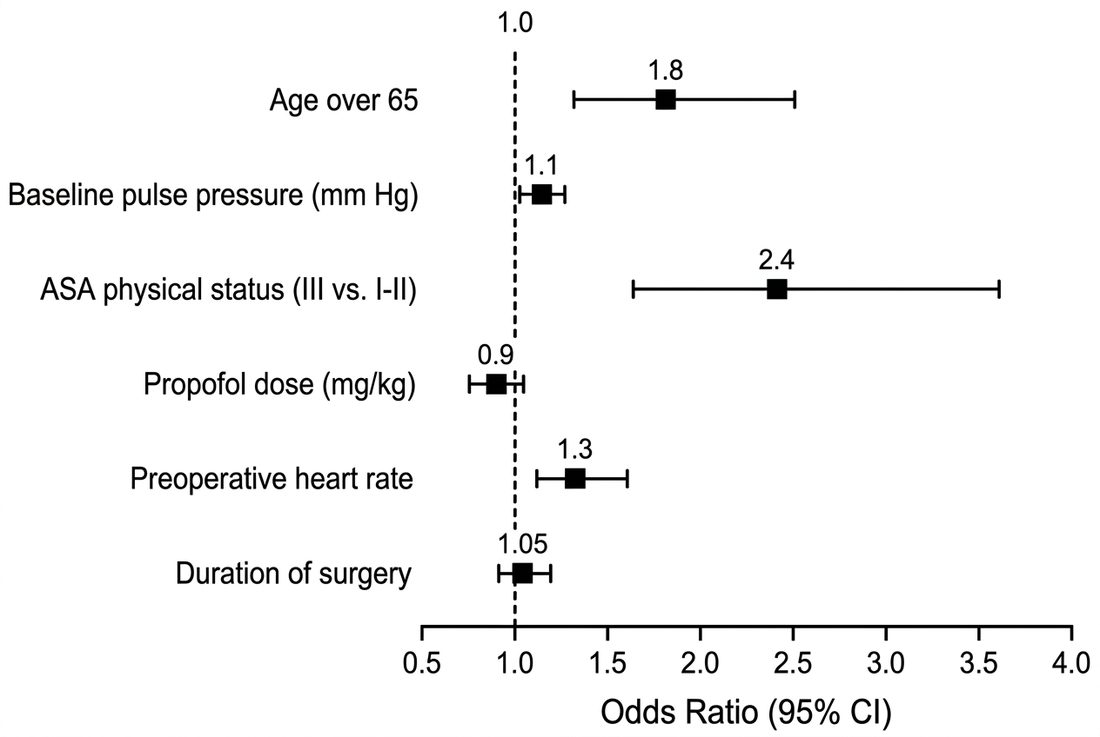
Results. PIH occurred in 148 patients (35.9%). Independent predictors were age >65 years (OR 2.31, 95% CI 1.48-3.60), baseline pulse pressure >60 mmHg (OR 1.92, 95% CI 1.21-3.04), ASA physical status III (OR 1.77, 95% CI 1.10-2.85) and propofol dose >2 mg/kg (OR 1.63, 95% CI 1.04-2.55).

Conclusions. One in three patients developed PIH. Age, elevated baseline pulse pressure, higher ASA status and higher propofol dose independently predicted PIH and may guide individualized induction strategies.

Keywords

post-induction hypotensiongeneral anesthesiapropofolrisk factorsperioperative

INTRODUCTION

Anesthetic induction frequently produces a transient fall in arterial pressure. Although often self-limited, post-induction hypotension (PIH) has been associated with acute kidney injury, myocardial injury and increased 30-day mortality. Reliable bedside predictors could allow anesthesiologists to modify induction technique in higher-risk patients. Hemodynamic stability during induction depends on the interplay between anesthetic-induced vasodilation, blunting of sympathetic tone and myocardial depression. In patients with limited cardiovascular reserve, even a modest reduction in preload or systemic vascular resistance may precipitate clinically important hypotension. Despite its frequency, PIH is often treated reactively rather than anticipated, and standardized preoperative risk assessment is lacking in routine practice.

METHODS

This single-center prospective cohort study enrolled consecutive adults (>=18 years) scheduled for elective non-cardiac surgery under general anesthesia over a 9-month period. Standardized monitoring was applied. PIH was defined as any mean arterial pressure <65 mmHg during the first 10 minutes after induction. Candidate variables were entered into a multivariable logistic regression model. A two-sided p<0.05 was considered significant.

RESULTS

Of 412 patients (mean age 58.4 +/- 15.2 years; 54% female), 148 (35.9%) developed PIH. Patients with PIH were older and more frequently had hypertension. In the adjusted model, age >65 years, baseline pulse pressure >60 mmHg, ASA III and propofol dose >2 mg/kg remained independently associated with PIH. Vasopressor rescue was required in 61 patients. Median time to the nadir of mean arterial pressure was 4.5 minutes after induction. Patients who developed PIH received more frequent fluid boluses and had a longer post-anesthesia care unit stay (median 138 vs 96 minutes, p<0.001). No patient experienced intraoperative cardiac arrest, and there were no anesthesia-related deaths in the cohort.

DISCUSSION

Our findings reinforce that hemodynamic reserve declines with age and vascular stiffening, reflected by wide pulse pressure. The dose-dependent effect of propofol supports titrated induction. Limitations include single-center design and the observational nature of the analysis. Anticipatory strategies such as slower titration of the induction agent, prophylactic vasopressors and judicious preloading may attenuate PIH in high-risk individuals. Continuous non-invasive arterial pressure monitoring could allow earlier detection than intermittent oscillometry. Prospective interventional trials are needed to determine whether individualized induction protocols translate into fewer postoperative complications.

CONCLUSION

PIH is frequent and predictable. Incorporating simple preoperative variables into induction planning may reduce the incidence and severity of hypotension.

article.figures

Independent predictors of post-induction hypotension
Figure 1. Independent predictors of post-induction hypotension Forest plot of adjusted odds ratios (95% confidence intervals) for the four variables independently associated with post-induction hypotension. The dashed line marks an odds ratio of 1.0.

References

  1. Reich DL, Hossain S, Krol M, et al. Predictors of hypotension after induction of general anesthesia. Anesth Analg. 2005;101(3):622-628.
  2. Sudfeld S, Brechnitz S, Wagner JY, et al. Post-induction hypotension and early intraoperative hypotension. Br J Anaesth. 2017;119(1):57-64.
  3. Wesselink EM, Kappen TH, Torn HM, et al. Intraoperative hypotension and the risk of postoperative adverse outcomes. Br J Anaesth. 2018;121(4):706-721.
  4. Salmasi V, Maheshwari K, Yang D, et al. Relationship between intraoperative hypotension and acute kidney injury. Anesthesiology. 2017;126(1):47-65.
  5. Sessler DI, Bloomstone JA, Aronson S, et al. Perioperative Quality Initiative consensus statement on intraoperative blood pressure. Br J Anaesth. 2019;122(5):563-574.
  6. Green RS, Butler MB. Postintubation hypotension in general anesthesia. J Intensive Care Med. 2016;31(10):667-675.
License:CC BY-NC 4.0