
Case Report
Incomplete Kawasaki Disease in a Young Infant: Diagnostic Challenge and Coronary Outcome
Hana Kim, MD*; Juan Restrepo, MD; Fatima Zahra, MD
Vol. 1, Issue 2 · April 20, 2026
Abstract
Background. Incomplete Kawasaki disease (KD) is difficult to recognize in young infants, who paradoxically face higher coronary risk.
Methods. A 4-month-old boy presented with prolonged fever and irritability without classic mucocutaneous features.
Results. Laboratory inflammation and echocardiographic coronary dilation prompted treatment. Intravenous immunoglobulin and aspirin were given; coronary dimensions normalized on follow-up.
Conclusions. Persistent unexplained fever in infants warrants consideration of incomplete KD and early echocardiography to prevent coronary sequelae.
Keywords
Kawasaki diseaseincompleteinfantcoronary aneurysmintravenous immunoglobulin
INTRODUCTION
KD is a systemic vasculitis and the leading cause of acquired heart disease in children in developed countries. Infants under six months often present with incomplete criteria, delaying diagnosis. Coronary artery aneurysms are the most feared complication of KD and are more common when treatment is delayed. Young infants frequently lack the full constellation of clinical criteria, and a high index of suspicion is required to avoid missing the diagnosis during the window in which immunoglobulin is most effective.
METHODS
We report the clinical course, laboratory data, echocardiographic findings and outcome.
RESULTS
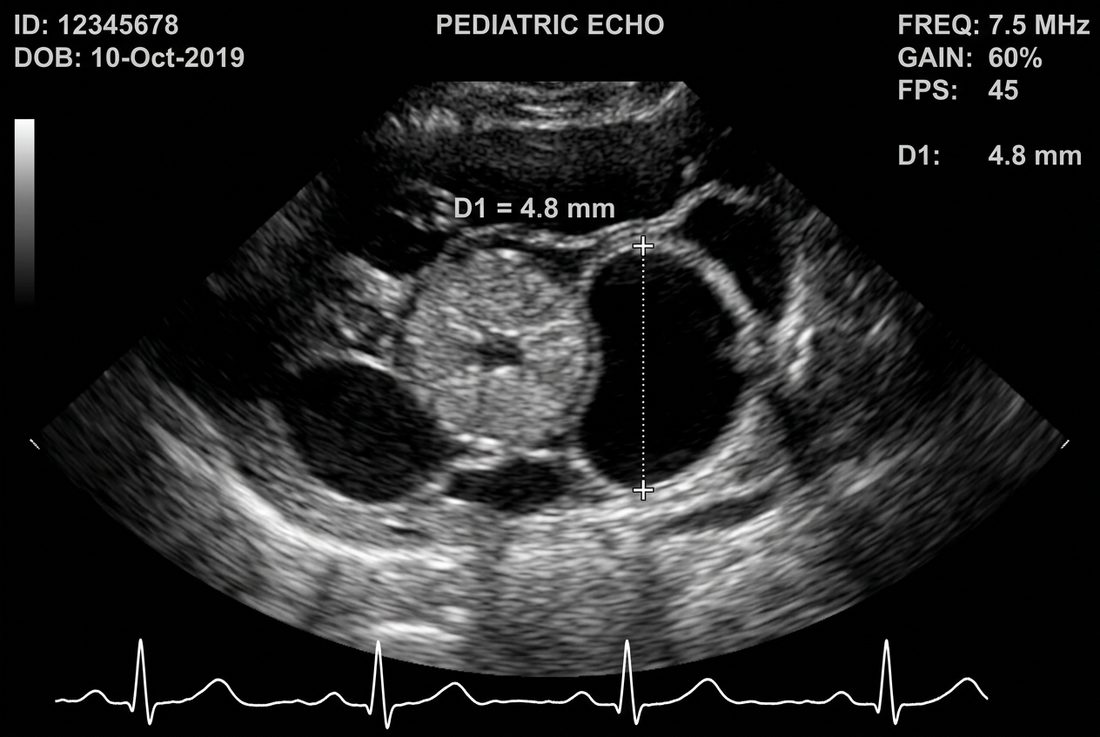
The infant had fever for seven days, elevated C-reactive protein, anemia, thrombocytosis and sterile pyuria. Echocardiography showed a dilated left anterior descending artery. After IVIG (2 g/kg) and aspirin, fever resolved and coronary dimensions normalized by week eight.
DISCUSSION
Applying the American Heart Association incomplete-KD algorithm enabled timely treatment. Young infants require a low threshold for echocardiography because they are at greatest risk of aneurysm. Serial echocardiography is essential to monitor coronary dimensions and guide antithrombotic therapy. Timely IVIG within the first ten days of illness markedly reduces the risk of aneurysm. This case illustrates the value of a structured diagnostic algorithm when classic features are absent.
CONCLUSION
Early recognition and treatment of incomplete KD in infants prevents coronary complications.
article.figures
References
- McCrindle BW, Rowley AH, Newburger JW, et al. Diagnosis, treatment, and long-term management of Kawasaki disease. Circulation. 2017;135(17):e927-e999.
- Yeom JS, Woo HO. Understanding the importance of cerebroside sulfate in Kawasaki disease. Korean J Pediatr. 2019;62(9):334-339.
- Salgado AP, Ashouri N, Berry EK, et al. High risk of coronary artery aneurysms in infants with Kawasaki disease. J Pediatr. 2017;185:112-116.