
Case Report
Amyand's Hernia: Incidental Appendicitis Within an Inguinal Hernia Sac - A Case Report
Sergio Beltran, MD*; Miguel Torres, MD; Chidi Okafor, MD
Vol. 2, Issue 2 · June 13, 2026
Abstract
Background. Amyand's hernia, the presence of the appendix within an inguinal hernia sac, is rare and usually diagnosed intraoperatively.
Methods. A 57-year-old man presented with a tender right inguinal swelling suggestive of an incarcerated hernia.
Results. At operation, an inflamed appendix was found within the hernia sac. Appendectomy and primary tissue repair were performed with an uncomplicated recovery.
Conclusions. Amyand's hernia should be considered in complicated inguinal hernias. Management depends on appendiceal inflammation and guides the choice of mesh versus primary repair.
Keywords
Amyand herniainguinal herniaappendicitishernioplastyappendectomy
INTRODUCTION
First described in relation to Claudius Amyand's 1735 appendectomy, this eponymous hernia is found in roughly 1% of inguinal hernia repairs. Acute appendicitis within the sac is even less common. The presence of the vermiform appendix within an inguinal hernia sac is an uncommon anatomical curiosity that occasionally becomes clinically important when the appendix becomes inflamed or incarcerated. Preoperative diagnosis is rare, and most cases are discovered incidentally at operation.
METHODS
We report the clinical presentation, operative findings, management and outcome.
RESULTS
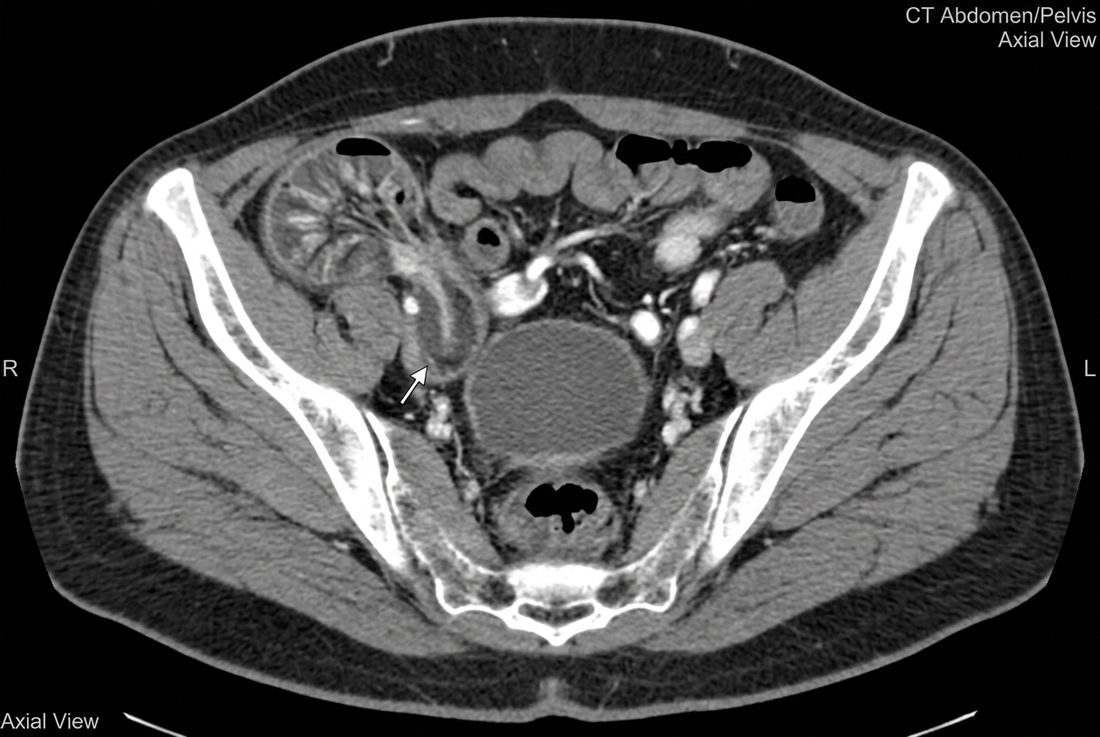
Ultrasound suggested an incarcerated hernia. Exploration revealed an acutely inflamed appendix within the sac (Losanoff-Basson type 2). Appendectomy through the hernia incision and primary (non-mesh) repair were performed. The patient recovered without infection.
DISCUSSION
The Losanoff-Basson classification guides management: mesh is avoided in the presence of appendiceal inflammation to reduce infection risk. Preoperative diagnosis is uncommon and imaging is often nonspecific. Management is dictated by the degree of appendiceal inflammation, as codified by the Losanoff-Basson classification. Prosthetic mesh is generally avoided in the presence of active inflammation to minimize infection risk. Awareness of this entity allows the surgeon to adapt the operative plan intraoperatively.
CONCLUSION
Surgeons should be prepared to encounter Amyand's hernia and tailor repair to the degree of appendiceal inflammation.
article.figures
References
- Losanoff JE, Basson MD. Amyand hernia: a classification to improve management. Hernia. 2008;12(3):325-326.
- Michalinos A, Moris D, Vernadakis S. Amyand's hernia: a review. Am J Surg. 2014;207(6):989-995.
- Ivanschuk G, Cesmebasi A, Sorenson EP, et al. Amyand's hernia: a review. Med Sci Monit. 2014;20:140-146.