
Original Research
Functional Outcomes of Percutaneous versus Open Reduction and Internal Fixation for Displaced Calcaneal Fractures
Nikhil Deshpande, MD*; Gabriel Santos, MD; Emma Larsen, MD
Vol. 1, Issue 1 · April 29, 2026
Abstract
Background. The optimal surgical approach for displaced intra-articular calcaneal fractures remains debated. We compared percutaneous and open techniques.
Methods. Retrospective comparative study of 96 patients (percutaneous n=44; open n=52). Outcomes were the AOFAS ankle-hindfoot score at 12 months and wound complications.
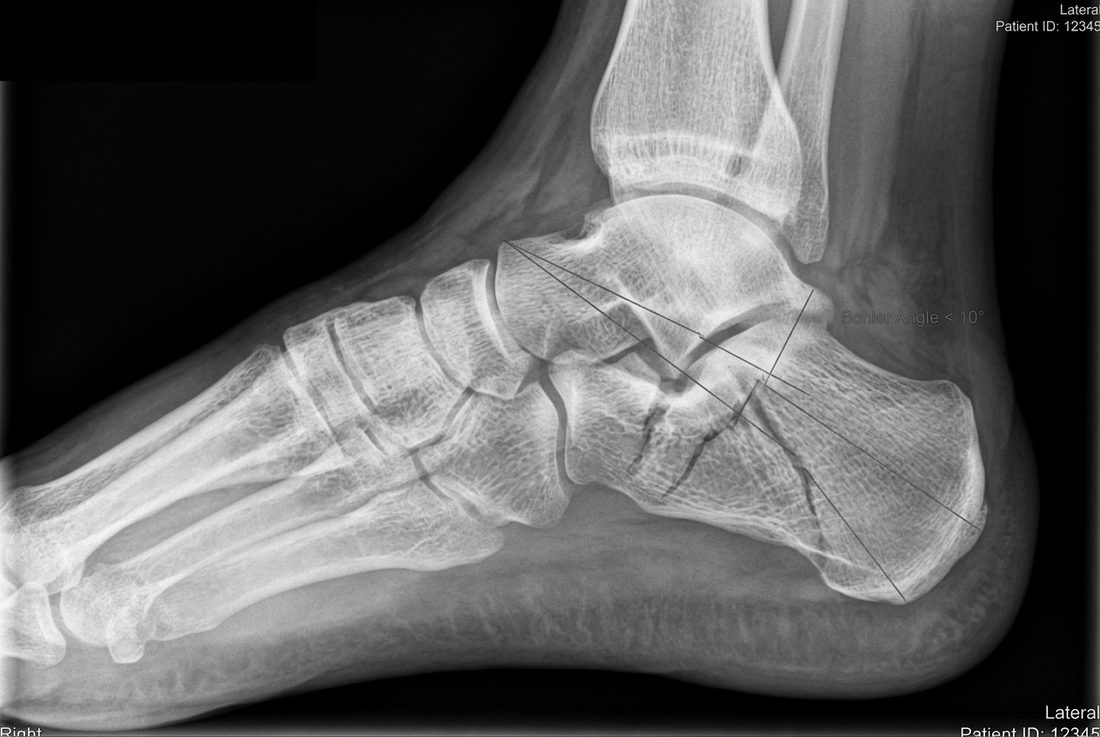
Results. Mean AOFAS scores were similar (percutaneous 82.1 vs open 80.6, p=0.42). Wound complications were significantly lower with the percutaneous approach (4.5% vs 19.2%, p=0.03), with comparable restoration of Bohler angle.
Conclusions. Percutaneous fixation achieves functional outcomes comparable to open surgery with fewer wound complications for selected fracture patterns.
Keywords
calcaneal fracturepercutaneous fixationopen reductionwound complicationsfunctional outcome
INTRODUCTION
Displaced intra-articular calcaneal fractures are challenging injuries. Extensile lateral approaches allow anatomic reduction but carry a substantial rate of wound complications. Minimally invasive percutaneous techniques aim to reduce soft-tissue morbidity. Displaced intra-articular calcaneal fractures typically result from axial loading and are associated with significant long-term disability. Restoration of the posterior facet, calcaneal height, width and alignment is the goal of surgery, but the fragile lateral soft-tissue envelope complicates open approaches.
METHODS
We reviewed adults treated surgically for Sanders type II-III calcaneal fractures over four years. Radiographic parameters (Bohler and Gissane angles) and the AOFAS score at one year were compared between percutaneous and open cohorts.
RESULTS
Both groups achieved similar radiographic correction and functional scores. The percutaneous group had significantly fewer wound complications and shorter hospital stay. Subtalar stiffness was comparable. Subtalar range of motion and return-to-work times were comparable between groups. Hardware removal was required in a minority of patients in each cohort.
DISCUSSION
For appropriate fracture morphology, percutaneous fixation offers a favorable balance of reduction quality and soft-tissue safety. Selection bias inherent to the retrospective design should be considered. Careful patient selection based on fracture morphology and soft-tissue status is central to good outcomes. Percutaneous techniques are most advantageous when the fracture pattern permits indirect reduction, whereas highly comminuted joint depression fractures may still require open articular reconstruction.
CONCLUSION
Percutaneous fixation is a valuable option for selected displaced calcaneal fractures, minimizing wound morbidity without sacrificing function.
article.figures
References
- Sanders R. Displaced intra-articular fractures of the calcaneus. J Bone Joint Surg Am. 2000;82(2):225-250.
- Buckley R, Tough S, McCormack R, et al. Operative compared with nonoperative treatment of displaced calcaneal fractures. J Bone Joint Surg Am. 2002;84(10):1733-1744.
- Zhang G, Ding S, Ruan Z. Minimally invasive versus extensile lateral approach for calcaneal fractures. Int Orthop. 2018;42(3):633-641.
- Griffin D, Parsons N, Shaw E, et al. Operative versus non-operative treatment for calcaneal fractures (UK HeFT). BMJ. 2014;349:g4483.