
Surgical Technique
Minimally Invasive Fixation of Weber B Ankle Fractures: A Reproducible Surgical Technique
Oscar Delgado, MD*; Nadia Haruna, MD; Peter Novak, MD
Vol. 2, Issue 1 · May 08, 2026
Abstract
Background. Soft-tissue complications after ankle fracture fixation can be reduced with minimally invasive techniques. We describe an approach for Weber B fractures.
Methods. The technique details reduction, percutaneous plate insertion and screw placement under fluoroscopy.
Results. The described steps allow anatomic reduction of the lateral malleolus with limited soft-tissue dissection.
Conclusions. Minimally invasive plate osteosynthesis is a reproducible option for Weber B ankle fractures, particularly in compromised soft tissues.
Keywords
ankle fractureWeber Bminimally invasivelateral malleolusplate fixation
INTRODUCTION
Weber B fractures of the distal fibula are common. Standard open plating risks wound problems, especially in diabetic or elderly patients. Minimally invasive plate osteosynthesis (MIPO) preserves the soft-tissue envelope. Ankle fractures are among the most common lower-limb injuries requiring surgery. Anatomic restoration of fibular length and rotation is essential to prevent post-traumatic arthritis, but wound complications after conventional plating remain a concern, especially in patients with diabetes, peripheral vascular disease or fragile skin.
METHODS
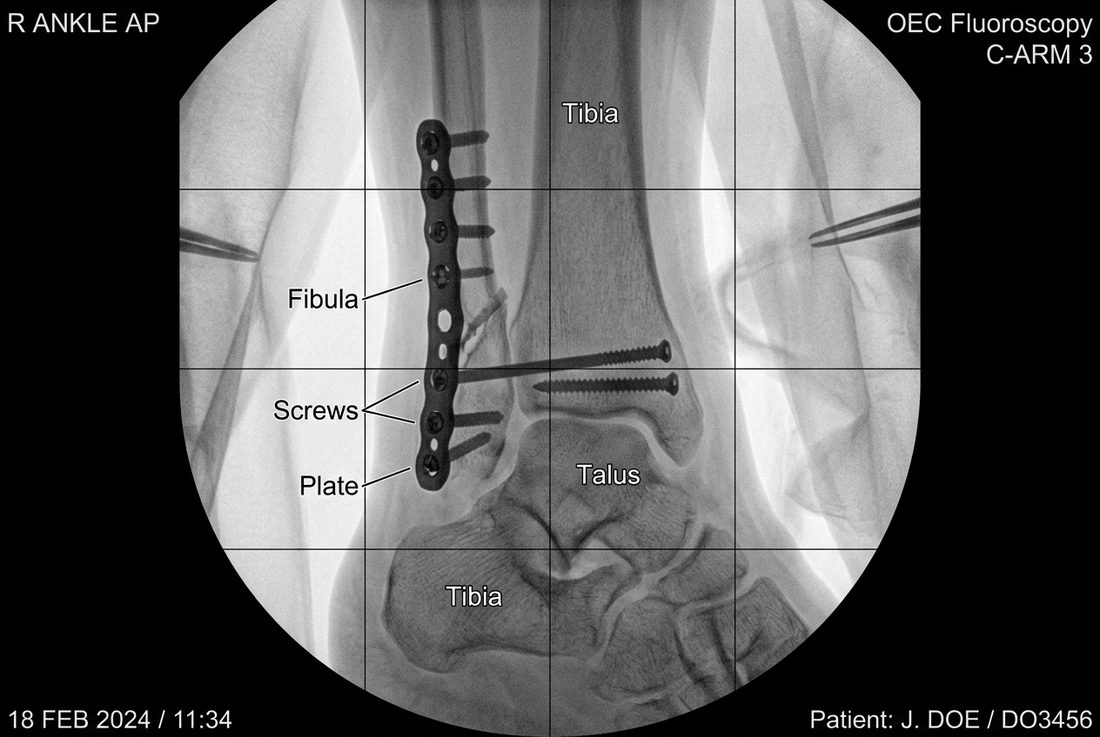
Under fluoroscopic guidance, closed reduction is achieved with the ankle in slight dorsiflexion. A small distal incision allows submuscular sliding of a precontoured one-third tubular plate. Screws are placed percutaneously through stab incisions. Syndesmotic stability is assessed intraoperatively.
RESULTS
The technique restores fibular length and rotation while minimizing periosteal stripping. Fluoroscopic checks confirm reduction and hardware position.
DISCUSSION
MIPO reduces wound complications and may accelerate recovery. Adequate closed reduction and familiarity with fluoroscopic landmarks are prerequisites. The technique is less suitable for severely comminuted patterns. Minimally invasive plate osteosynthesis preserves the periosteal blood supply and reduces the soft-tissue insult. The technique demands meticulous closed reduction and confident interpretation of fluoroscopic landmarks. Careful intraoperative assessment of syndesmotic stability remains mandatory regardless of the approach chosen.
CONCLUSION
MIPO offers a safe, reproducible alternative to open plating for suitable Weber B ankle fractures.
article.figures
References
- Lauge-Hansen N. Fractures of the ankle. Arch Surg. 1950;60(5):957-985.
- Tornetta P, Creevy W. Lag screw only fixation of the lateral malleolus. J Orthop Trauma. 2001;15(2):119-121.
- Hess F, Sommer C. Minimally invasive plate osteosynthesis of the distal fibula. Oper Orthop Traumatol. 2011;23(4):321-330.